
My name is Nat, and I’m a mentor at MindJam. I’m autistic, and gaming has been a big part of my life for as long as I can remember. Looking back, some of those games gave me ways of understanding myself and the world around me that I didn’t recognise at the time.
Growing up autistic, the world often felt like it was running on rules everyone else seemed to understand instinctively.
People said one thing and meant another. Social situations changed depending on who was involved. There seemed to be expectations everywhere, but very little explanation of what those expectations actually were.
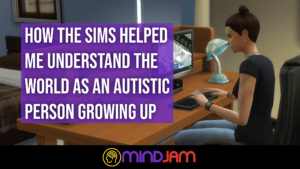
The Sims gave me something different.
It gave me a world where people, relationships and everyday life were turned into systems I could see, test and understand. Looking back, I think that mattered to me far more than I realised at the time.

Learning the patterns behind social life
Human interaction has often felt unpredictable to me. The Sims made it more concrete.
If I wanted two Sims to become friends, there were actions I could take. Relationships changed depending on how they treated each other. Ignoring someone’s needs had consequences. Spending time together generally strengthened a relationship.
I could experiment with all of this without the anxiety that came with experimenting socially in real life.
What happens if I introduce myself? What makes a friendship grow? What happens if someone is repeatedly ignored? How much interaction is too much?
In real life, getting those things wrong could mean embarrassment, confusion or accidentally upsetting somebody without understanding why. In The Sims, I could try something, watch what happened and try something else.
It sounds very mechanical when I describe it now, but that was part of what made it useful to me. The game translated parts of social life into patterns I could analyse.
I sometimes think of them as social algorithms.
Of course, real people are far more complicated than Sims. But the game gave me an early framework for understanding things that weren’t otherwise being explained to me – that relationships need attention, that people have competing needs, that someone’s mood affects how they respond, and that actions can change a relationship over time.
Those ideas may seem obvious to some people. They weren’t obvious to me.

Having control over something
Another huge part of The Sims for me was control.
As a child, I had very little autonomy. Adults decided where I went, what I did, what was expected of me and what counted as appropriate behaviour. At the same time, being autistic meant that the world could feel overwhelming and difficult to predict.
Then I could open The Sims and be responsible for an entire household.
I could choose what my Sims ate, where they lived, what jobs they had, who they spent time with and what they did with their day. I could build their home from scratch and change it whenever I wanted. If something wasn’t working, I could pause, rethink it and try something different.
I don’t think that was simply escapism.
There was something genuinely important about having a space where my decisions mattered and where I was allowed to be completely in control.
When so much of childhood felt decided for me, The Sims gave me somewhere I could exercise autonomy safely.

Exploring who I might be
The Sims also gave me room to explore identity long before I had the language to understand my own.
Growing up, I believed I was a girl because that was the category I had been given. I didn’t know that being non-binary was an option. I didn’t have the vocabulary or examples that might have helped me question what I had been told about myself.
But in The Sims, I could try different lives.
I could play as men or women. I could create families that looked nothing like the one I knew. I could make straight couples, queer couples or Sims who didn’t have relationships at all. I could explore different roles without having to explain why I was interested in them.
There was no pressure to come to a conclusion. I didn’t need to declare that something meant anything about me.
I could just experiment.
Looking back, I think that freedom mattered. The game gave me somewhere to explore possibilities before I necessarily understood that they were possibilities available in real life too.

A different kind of learning
The Sims wasn’t designed to teach autistic children how the world works, and I wouldn’t pretend that a simulation game can accurately explain human behaviour.
But for me, it did something that more conventional ways of learning often failed to do.
It let me interact with systems rather than simply being told about them.
I could test cause and effect. I could repeat situations. I could pause. I could make mistakes without social consequences. I could change one thing and see what happened next.
That suited the way my brain learns.
And because I was enjoying myself, nobody needed to persuade me to practise any of it. I spent hours doing it because I wanted to.

Looking back
I still love The Sims as a game, but when I look back at what it meant to me growing up, I can see that it was doing much more than keeping me entertained.
It gave me a simplified model of a world I was struggling to understand.
It gave me somewhere to experience control when I had very little of it elsewhere.
And it gave me space to explore identity without needing the right words first.
None of that means every autistic person will experience The Sims in the same way. This is simply what it became for me.
The things that help a young person make sense of themselves do not always look particularly important from the outside. They might look like a game they spend far too much time playing.
But inside that game, they may be experimenting, processing, learning, recovering or exploring things they do not yet know how to explain.
For me, The Sims was one of those places.